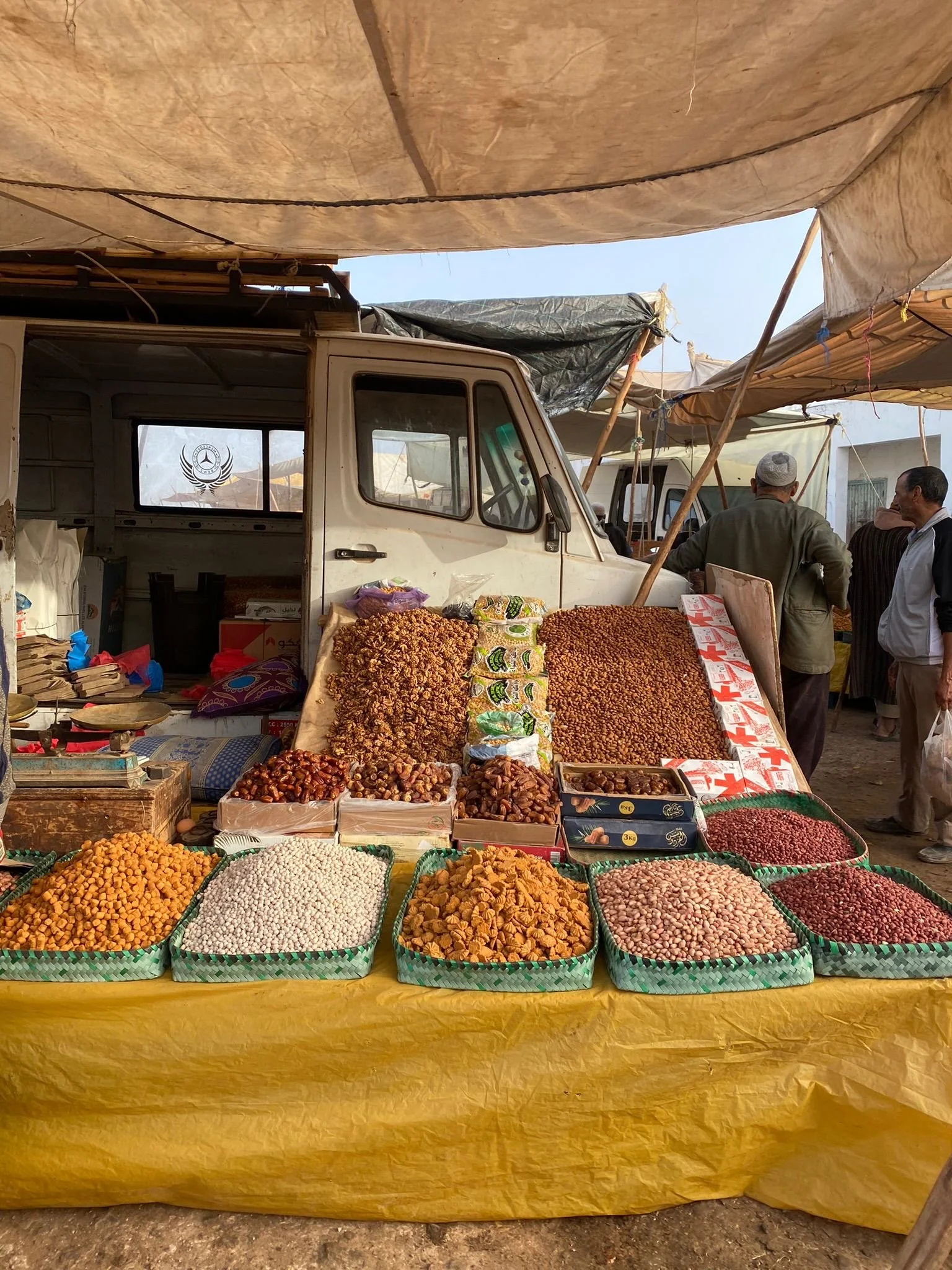
"The Had Draa Market" by Anthony Darin
My professor tells me that there are two Moroccos. First, there is Maroc–the French speaking, European-like neighborhoods where Morocco’s colonial history is evident around every avenue. After spending so much time in Rabat, it was hard to imagine that any other Morocco could exist, but after visiting the Sunday market in the rural village of Had Draa, I was introduced to what my professor calls Al-Maghreb–the Morocco that has resisted this assimilation. The café filled squares in nearby Essaouira could be reminiscent of those in Paris with their French menus and pastries. However, as our taxi moved closer to the village, the squares gave way to dirt roads filled with the sounds of Darija (the Moroccan dialect of Arabic) and livestock, exemplifying the vast differences between urban and rural life in Morocco.
Shortly after stepping out of the taxi, a police car pulled over next to us as we walked down the village’s main street. The officer rolled down his window, and with a confused look on his face, he asked, “Are you lost?” It was clear that we had entered a part of Morocco that was lesser known to the tourists visiting for Essaouira’s famous waves or the Moga Music Festival.
Entering the market was overwhelming to the senses, particularly because of the many spice stalls that lined the path through the main gate. The market seemed to have everything you could want. From antique coins dating back to the French colonial period, to modern electronics, the market reflected both the old and the new, all converging in an organized flurry of sounds and sights. After a quick, but very necessary, stop to buy some cookies, we made our way through the market, first through the section filled with spices and other miscellaneous goods, and then into the produce section. Here, we were kindly offered free slices of watermelon from one of the vendors as we passed by, and despite our best attempts to pay, the man refused to accept our offer.
We then made our way to the animal market. Here, sheep, cattle, and donkeys were all for sale, roaming around a large dirt field among their owners and potential buyers. While we couldn’t take any animals home with us (as customs would probably be less than enthused), we did get to take turns milking a cow, albeit to varying degrees of success. We had plenty of fun while trying to communicate the steps of milking a cow in our limited Darija, but the experience was also eye-opening in that it revealed just how integral these animals were for survival in rural Morocco. Whether it be wool, milk, food, or transportation, these animals provided for people in places where supermarkets like Marjane or Carrefour didn’t.
After visiting Had Draa, it became clear to me that Maroc and Al-Maghreb weren’t two separate places, but rather two identities intertwined into one place. French colonial-era coins and clothes made in Pakistan sat next to the local produce grown in nearby villages. Here in Had Draa Market, the past and the present, the local and the foreign, and the traditional and the modern all converge to actively shape a diverse society that can only be described as Moroccan.
Anthony Darin is a student at American University and studied abroad in the Fall 2025 on Amideast’s Area & Arabic Language Studies program in Rabat, Morocco.